Voltage and Current Regulators
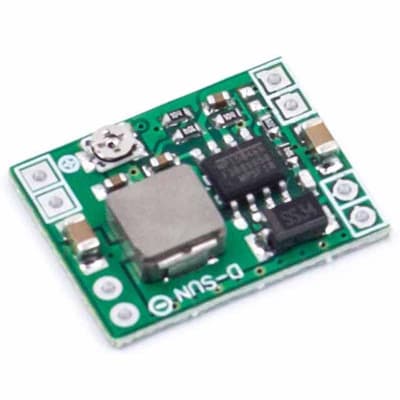
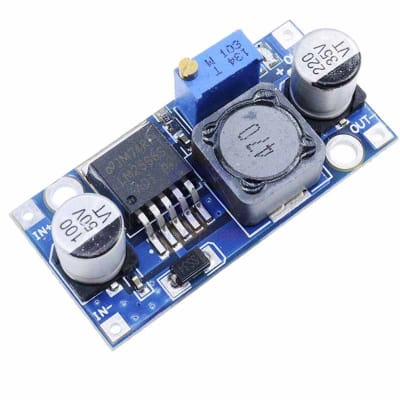
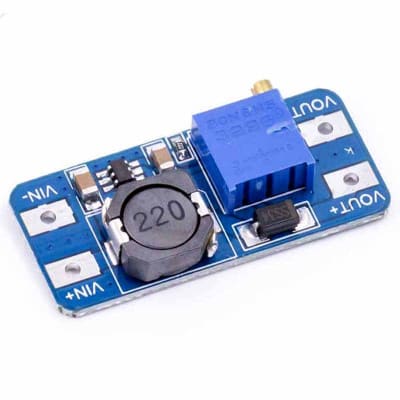
DC-DC voltage regulators — LM2596 step-down, MT3608 step-up and MP1584EN mini step-down. Get a stable 5V or 3.3V for Arduino/ESP32 from a battery, adapter or car 12V.
Voltage and Current Regulators — buying guide
The voltage you need often doesn’t match your project’s power source: you may need 5 V from a 12 V battery, or 5 V from a 3.7 V lithium cell. The DC-DC modules in the Voltage and Current Regulators category do this with relatively low heat dissipation.
Which one to choose?
- Step-down, standard size: LM2596S is a buck converter, stepping 4.5–40 V input down to 1.23–37 V. A classic choice for getting 5 V from 12 V.
- Step-down, compact size: MP1584EN is smaller, stepping 4.5–28 V input down to 0.8–20 V.
- Step-up: MT3608 is a boost converter, providing up to 28 V output from a 2–24 V input.
How to set it up?
- Connect the module to the input source with no load attached.
- Connect a multimeter to the output and adjust the trimmer to set the voltage.
- Then connect the load and check the voltage again.
Do not reverse the input polarity; the module is not protected. With a buck converter, the input must be about 2 V higher than the output. With a boost converter, the output cannot be lower than the input. Also calculate the current: as a boost converter raises the voltage, it draws more current from the input than it delivers to the output.
The current rating given for the modules is the absolute maximum. Leave some safety margin for continuous operation.
Typical projects
- Powering a board from a car’s 12 V line.
- Getting 5 V for an ESP32 from a lithium cell.
- Getting 5 V or 3.3 V from 24 V in a small device.
Related categories
How are these modules different from an LM7805 regulator?
An LM7805 turns the excess voltage into heat and gets very hot when dropping 12 V down to 5 V. A DC-DC converter has much lower losses, but there is some residual noise on the output.
How do I set the output voltage accurately?
Slowly turn the trimmer with no load connected. On a multi-turn trimmer the change may not be visible immediately; you may need to turn it several times.