Micro:Bit Boards
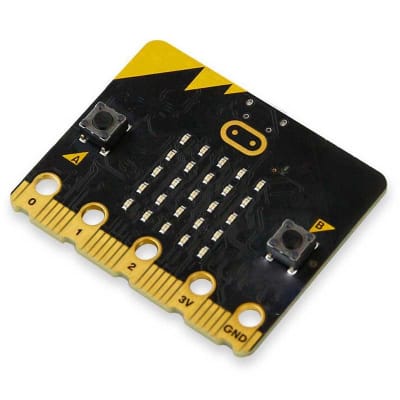
BBC micro:bit V2.2 — a ready-made teaching board with a 25-LED matrix, two buttons, accelerometer, compass, microphone, speaker and Bluetooth on board. The easiest entry to coding for schools and ages 8–14: program it with blocks (MakeCode) or Python.
Micro:Bit Boards — buying guide
BBC micro:bit is a pocket-sized programmable board designed for children and beginners. Since it has an LED matrix, buttons and sensors on board, you can run your first program without any additional components.
What to look for
- What’s on the board: The BBC micro:bit V2.2 board includes a 5×5 LED matrix, two buttons, accelerometer, compass, temperature sensor, microphone, speaker and Bluetooth.
- Programming: MakeCode uses blocks, while Python uses text. Both run in the browser, so you don’t need to install any software on your computer.
- Power: the board can be powered from USB or a 3 V battery pack.
- Modules: the pins are 3.3 V. Before connecting any module that runs on 5 V, check that it also works at 3.3 V.
Typical projects
- An electronic dice that shows a number on the screen when you shake it.
- A thermometer that shows the room temperature on the LED matrix.
- Sending messages between two micro:bits over radio.
Related categories
micro:bit or Arduino?
For school-age beginners and a first programming lesson, micro:bit is simpler because everything is on the board. If you want to learn more electronics with motors, sensors and larger projects, Arduino offers more possibilities.
How is V2 different from the earlier micro:bit?
The V2 has a built-in microphone, speaker and touch-sensitive logo, and a faster processor. These additions let you build projects that use sound and touch.