Charging Modules
Charging modules — TP4056 lithium battery charger (with and without discharge protection) and Li-ion/LiPo BMS protection boards. The first part of any project running on 18650 or LiPo cells.
Charging Modules — buying guide
Charging modules are used to charge and protect lithium batteries. These batteries can be damaged if charged incorrectly or over-discharged, so this job is handed over to a ready-made module.
Which one to choose?
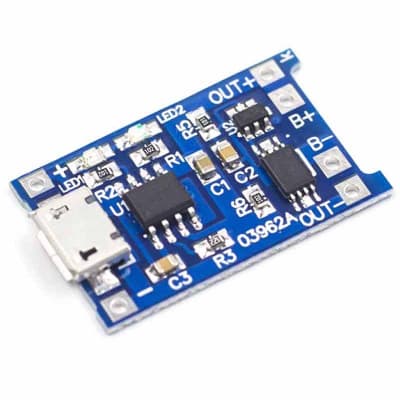
- Single cell, with protection: TP4056 with protection charges the battery up to 4.2 V with a 1 A current, and protects it from overcharge and over-discharge. If the battery is powering the project directly, choose this one.
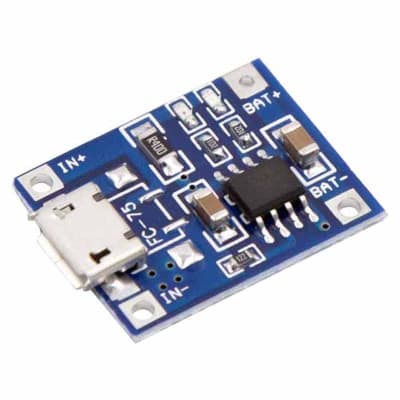
- Single cell, without protection: TP4056 without protection only charges the battery. It is suitable if the battery itself has built-in protection or there is a separate protection circuit in the design.
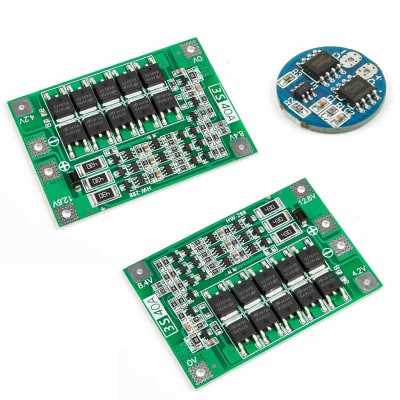
- Several cells in series: BMS is available in 2S 7 A (8.4 V), 3S 40 A (12.6 V) and 4S 40 A (16.8 V) variants. Choose according to the number of cells.
Compatibility
- TP4056 runs from 5 V, and its output is the battery voltage. If your project needs a stable 5 V, add an MT3608 step-up regulator.
- On the protected module, the load is connected to the OUT pins, not directly to the battery pins; otherwise the protection will not work.
- For a small battery, 1 A might be too high. The charging current is set by the resistor on the board.
- Cells connected to a BMS must be the same model and have the same voltage.
Do not charge swollen or damaged batteries. Do not leave the battery unattended while charging, and do not reverse the polarity.
Typical projects
- ESP32 device powered from an 18650 cell.
- Portable Bluetooth speaker.
- New battery pack for an old tool.
Related categories
TP4056 with or without protection?
If the battery itself does not have a protection board, choose the protected module. If you are not sure, the protected version is safer.
Can TP4056 charge two cells together?
Not two cells in series; the module is for a single cell. You can charge cells connected in parallel, but their voltages must be equalized beforehand.